
Quick answer: why did Zomato acquire Blinkit?
Zomato bought Blinkit (formerly Grofers) in 2022 to move from food delivery into 10-minute grocery and quick commerce. Its board approved the deal on 24 June 2022 and it closed on 10 August 2022. Zomato paid ₹4,447.5 crore (about US$570 million) in new shares for Blink Commerce, the company behind Blinkit, plus ₹60.7 crore in cash for a related warehousing business. The total was ₹4,508 crore (US$578 million), according to Zomato’s own shareholder letter filed with the stock exchanges.
In Ansoff terms it is product development with a diversification flavour: a new product line for largely existing urban customers, run on Zomato’s delivery network and brand. Why it still matters: in fiscal Q2 FY27 (Jul–Sep 2026), Blinkit’s net order value was ₹20,940 crore, against ₹11,445 crore for Zomato’s food delivery, and Blinkit reported a positive adjusted EBITDA of ₹184 crore.
Company snapshot: from Zomato to Eternal Ltd
Zomato was a food-delivery company when it bought Blinkit; today the listed company is Eternal Ltd, and Blinkit is its largest business by order value.
Zomato in 2022. Zomato’s shareholder letter put fiscal 2022 adjusted revenue at ₹5,540 crore, with an adjusted EBITDA margin of minus 18%, improved from minus 153% in fiscal 2019. It held ₹12,219 crore in cash and already owned about 9% of Blinkit after a US$100 million investment in August 2021.
Blinkit in 2022. Grofers had run next-day grocery delivery and switched fully to quick commerce in January 2022, renaming itself Blinkit. By May 2022 it had about 400 dark stores, down from 450+ in January, because it closed stores that were not scaling.
Zomato becomes Eternal. The Registrar of Companies approved the new corporate name with effect from 20 March 2025, while the Zomato app and brand stayed for food delivery. Eternal now spans Zomato, Blinkit, District (going-out) and Hyperpure (B2B supply). Founder Deepinder Goyal said the group had used “Eternal” internally since the Blinkit deal to separate the company from the app.
Blinkit’s net order value passed Zomato’s food delivery for the first time in fiscal Q1 FY26 (Apr–Jun 2025): ₹9,203 crore against ₹8,967 crore.
Earlier in 2026, Blinkit founder Albinder Dhindsa succeeded Deepinder Goyal as Eternal’s CEO. The founder of the acquired company now runs the buyer.
Blinkit before and after
| Measure | May 2022, at the deal | Fiscal Q2 FY27 (Jul–Sep 2026) |
| Dark stores | About 400 | 2,751, with 308 added in the quarter |
| Orders | About 7.9 million in the month | 398.9 million in the quarter, or about 133 million a month (monthly figure is my arithmetic) |
| Order value | GOV of ₹403 crore in the month | NOV of ₹20,940 crore in the quarter, about ₹6,980 crore a month |
| Profit | Monthly loss of ₹204 crore in Jan 2022 | Adjusted EBITDA of +₹184 crore, 0.9% of NOV |
The two columns are not like-for-like. GOV counts gross value, NOV subtracts discounts, and since 2025 Blinkit has sold mostly from its own inventory, so its reported revenue now includes the full value of goods sold. That is why this post leans on order value and store counts, not revenue.
Which Ansoff strategy is Zomato’s Blinkit deal?
Product development is the closest Ansoff box, with a diversification flavour.
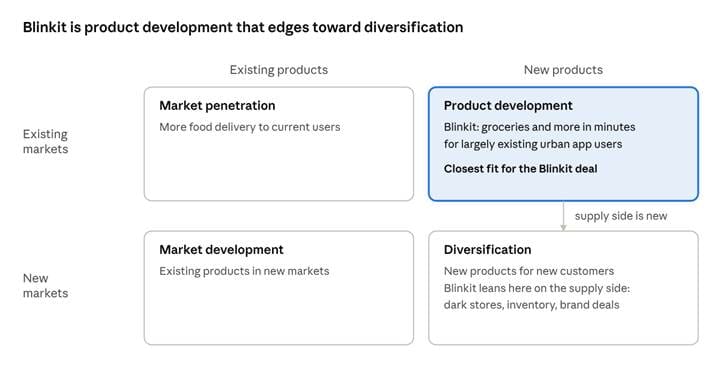
Ansoff matrix · Blinkit in product development
Ansoff’s matrix crosses products with markets. Blinkit was a new product for Zomato, aimed mostly at the same urban, app-first customers, so it sits in product development. The supply side was new too, so the deal leans toward related diversification: new activities that reuse Zomato’s delivery network, brand and engineering.
Why it is not a clean fit
- Customer overlap is the test. For pure product development, most Blinkit customers would already have been Zomato users. The filing text I read does not state the overlap.
- A separate app. Zomato kept Blinkit’s app and brand apart, so reaching existing customers meant cross-promotion, not one product.
- A new supply side. Dark stores, inventory and ties to consumer-goods brands, which pay for advertising, were all new to Zomato.
- Shared capabilities. Zomato’s case was that its riders and hyperlocal logistics were reusable, and that grocery demand peaks outside meal times. That reuse is the “related” in related diversification.
- Direction, not method. Ansoff describes where a firm grows, not whether it buys or builds. Zomato’s build-versus-buy answer was speed.
Quick commerce unit economics in plain words
A dark store makes money only when it fills up: rent, staff and power are fixed, so profit depends on orders per store per day, basket size and what the platform earns per order.
A dark store is a small warehouse closed to the public. Zomato’s 2022 letter said Blinkit’s delivery radius is typically under 2 km, with an average ride of 7–9 minutes. Three levers decide the margin:
- Revenue per order: commission, delivery and handling fees, and advertising from brands.
- Cost per order: last-mile delivery, store operations, restocking and wastage.
- Orders per store: more orders spread the fixed costs, which Zomato called operating leverage.
Contribution margin versus adjusted EBITDA. Contribution is what is left after the direct costs of serving orders. Adjusted EBITDA is what remains after central costs too. In fiscal Q2 FY27, Blinkit reported a contribution margin of 5.3% of net order value and an adjusted EBITDA margin of 0.9%. The 4.4-point gap (my arithmetic) is where overheads and the cost of ramping new stores sit.
Volume and basket size. Blinkit’s net average order value was ₹525 and about 398.9 million orders were placed in the quarter. Spread over the average store count, that is roughly 1,700 orders a store a day (my arithmetic). Swiggy reports 1,192 orders per Instamart dark store per day, though the definitions differ slightly.
Swiggy also spells out what break-even needs. Instamart would need about 2.3 times today’s scale, or ₹60,000 crore of annualised net order value, and ₹30 of contribution per order. Roughly two-thirds of the gain is meant to come from higher revenue per order and one-third from lower cost per order.
Metros versus smaller cities: what “10 minutes” means
The 10-minute promise was a metro-density idea: many customers within a short ride of one store. In 2022 Zomato said quick commerce was most obvious in large cities and that Blinkit focused on roughly the top 15.
Eternal now plans to pass 3,500 stores by March 2027 and about 5,000 by March 2028, most of them in smaller cities. It says new smaller-city stores reach about 1,000 orders a day as fast as metro stores, with average order values at 85–90% of metro levels. Spend per store has risen from ₹1 crore to ₹2.5 crore as stores get larger.
In January 2026 Blinkit dropped its “10-minute” branding after the Labour Ministry raised gig-worker safety concerns, and rivals followed. The sources I reviewed give no delivery-time figure for smaller cities, so treat “10 minutes everywhere” as unproven.
Why India’s model differs from Instacart, DoorDash and Getir
Instacart and DoorDash mostly deliver from existing stores and restaurants, while Gorillas and Getir copied the dark-store model in Europe. Getir bought Gorillas in December 2022 for US$1.2 billion and in April 2024 left the UK, Germany, the Netherlands and the US. Press accounts blame inflation, rising wages, thin grocery margins and shoppers returning to stores. India’s dense neighbourhoods let one store serve many homes within 2 km, and delivery labour costs less per order. I found no per-order cost comparison, so that last point is the usual explanation, not a measured one.
Blinkit vs Zepto vs Swiggy Instamart: who else is in the race?
Indian quick commerce has three scaled specialists, Blinkit, Zepto and Swiggy Instamart, and a growing group of e-commerce and retail giants behind them.
- Swiggy Instamart. In fiscal Q2 FY27 (Jul–Sep 2026) it had 1,240 dark stores in 133 cities and net order value of ₹6,594 crore. Its contribution margin was minus 1.0% of gross order value and its adjusted EBITDA loss was ₹895 crore. Swiggy says losses peaked this quarter.
- Zepto. It is unlisted. Its updated draft IPO prospectus shows fiscal 2026 (Apr 2025–Mar 2026) revenue of ₹22,623 crore and a net loss of ₹5,905 crore, with 1,139 dark stores at year-end. Reports say it has paused its IPO.
- BigBasket (Tata). Its BB Now format had 497 dark stores in the top 10 cities, according to CLSA data reported by Business Standard.
- Flipkart Minutes. The same CLSA data put it at 627 top-10-city dark stores, ahead of Instamart’s 615.
- Amazon Now. Amazon says it reached US$1 billion in annualised gross sales over the latest three months, with orders doubling every quarter since launch.
The e-commerce majors matter because they can fund losses from a larger business. Swiggy expects them to stay active through the festive quarter and says competitive intensity will not ease soon. Blinkit’s own pitch is to widen its range until the line between quick commerce and e-commerce blurs.
Market-share estimates differ widely by source and date, so this post compares published company metrics instead. See the table below.
What went right, and is quick commerce profitable in India?
Only partly. Blinkit now reports a positive adjusted EBITDA, but at 0.9% of net order value it is thin, and Instamart and Zepto still lose money.
What went right
- Speed. Zomato said building in-house would cost time and talent. In four years Blinkit grew from about 400 dark stores to 2,751 and overtook food delivery on order value.
- Operating leverage is visible. Blinkit’s adjusted EBITDA margin has improved for six straight quarters. Mature cities run above 5%, cities making up about 70% of net order value are adjusted-EBITDA positive, and about 96% is contribution-positive.
- A cash engine next door. Eternal’s food delivery earned an adjusted EBITDA of ₹627 crore in the quarter, which can help fund Blinkit’s growth, while Instamart lost ₹895 crore at Swiggy.
What is still unproven
- Timing. In 2022 Zomato’s CFO guessed Blinkit could reach adjusted EBITDA break-even in under three years, calling it an educated guess, not guidance. Blinkit still lost ₹156 crore in fiscal Q2 FY26 (Jul–Sep 2025) and has reported a positive adjusted EBITDA in the two latest quarters.
- Capital for expansion. Reaching 3,500 stores by March 2027 needs 749 more openings. At the new ₹2.5 crore per store, that is roughly ₹1,870 crore (my arithmetic). Eternal’s cash fell ₹1,813 crore in the quarter to ₹16,475 crore, which a trade report ties to seasonal inventory build-up.
- Smaller-city profits. New stores there fill up quickly, but the 5%-plus margin is for mature cities only.
- Inventory risk. Blinkit now owns most of its stock. Inventory losses were about 1.8% of net order value in fiscal Q1 FY27, a figure from the shareholder letter and not the audited accounts.
- Competition and rules. Amazon, Flipkart and Tata are spending, and Eternal itself has called quick-commerce competition irrational. Gig-worker welfare rules, including the new labour codes, may add cost.
- Definitions. Adjusted EBITDA is not net profit. Zomato’s 2022 definition added back share-based pay and treated rent as a cash cost.
What can MBA students and founders learn from Zomato–Blinkit?
The deal is a good teaching case because the logic, the price and the risks were all published, so each can be tested against what happened next.
- Buy when speed and team are scarce. Zomato’s build-versus-buy answer was speed and talent: building in-house would cost time and pull people off food delivery. It also already held about 9% of Blinkit, so it knew the asset.
- Pay in stock and cap the downside. About 629 million new shares (6.88% dilution) meant the price did not draw on Zomato’s ₹12,219 crore cash balance, apart from ₹60.7 crore for the warehousing unit. It also set an upper bound of US$400 million for quick-commerce spending over 2022–23, described as a ceiling and not a target.
- Fix store economics before scaling. Blinkit closed unviable stores, going from 450+ to about 400, while sales per store rose. Large-scale expansion came afterwards.
- Keep brands apart when customers think differently. Zomato argued that strong single-purpose brands would work better in India than one super app, so Blinkit kept its own app. The parent was later renamed Eternal.
- Expect the business model to change. Blinkit moved from a marketplace to owning inventory, with about 80% of net order value on its own stock by Jul–Sep 2025. Swiggy needed a shareholder vote on foreign ownership to follow. Rules shape strategy.
- Read the metrics, not the headline. Gross and net order value differ, revenue definitions changed in 2025, and Swiggy states margins as a share of gross value while Eternal uses net value. Never compare them without checking.
- Governance is part of the case. The deal drew criticism over disclosures. Deepinder Goyal answered in an August 2022 shareholder letter, citing due diligence and, as reported, more than 97% of votes in favour.
Questions to discuss.
- Is Blinkit product development or diversification? What customer-overlap data would settle it?
- Would you have built quick commerce in-house? What would it have cost in time?
- Which risk matters most for 2027: capital needs, competition or labour rules?
Read this alongside our Paytm case study and Byju’s case study to compare how three Indian startups handled growth, capital and governance.
Comparison table: Blinkit vs Zepto vs Swiggy Instamart
Blinkit is about three times Instamart’s size on orders and net order value (my arithmetic), and it is the only one of the three reporting a positive adjusted EBITDA. Published figures only, as of 6 November 2026.
| Platform | Period | Dark stores | Orders | Net order value | Contribution margin | Adjusted EBITDA | Source and date |
| Blinkit (Eternal Ltd) | Fiscal Q2 FY27 (Jul–Sep 2026) | 2,751 | 398.9 million | ₹20,940 crore | 5.3% of net order value | +₹184 crore, 0.9% of net order value | Eternal shareholder letter, 21 Oct 2026, as reported by the press |
| Swiggy Instamart | Fiscal Q2 FY27 (Jul–Sep 2026) | 1,240 in 133 cities | 130.3 million | ₹6,594 crore | Minus 1.0% of gross order value | Minus ₹895 crore, minus 9.7% of gross order value | Swiggy shareholder letter, 22 Oct 2026 |
| Zepto | Fiscal 2026 (Apr 2025–Mar 2026), full year | 1,139 in 66 cities | About 640 million | Not reported | Not reported | Minus ₹5,042 crore, about ₹79 per order | Updated draft IPO prospectus, June 2026, as reported by the press |
How to read the table:
- Periods differ. Zepto is unlisted and publishes less often. Its January–March 2026 quarter had about 210 million orders, the closest quarterly view.
- Margin bases differ. Eternal states margins on net order value and Swiggy on gross order value. Gross is larger, so the same rupee profit shows as a smaller percentage.
- Adjusted EBITDA is each company’s own definition. Zepto’s fiscal 2026 net loss was ₹5,905 crore.
- Revenue is left out. Blinkit’s revenue now includes the full value of goods sold, so it cannot be compared with a marketplace’s.
- Blinkit figures come from press reports of the letter. ⚠ CHECK: compare them with Eternal’s own letter, then delete this bullet.
Frequently Asked Questions (FAQs)
Why did Zomato acquire Blinkit?
Zomato wanted a bigger share of each customer’s spending and busier delivery riders outside meal times. It also said buying was faster than building, because of Blinkit’s technology, supplier relationships and team. It paid ₹4,508 crore in total, or US$578 million.
Which Ansoff strategy is Zomato’s Blinkit deal?
It is closest to product development: a new offering for largely existing urban customers. It has a diversification flavour because dark stores, inventory and brand relationships were new to Zomato. The Ansoff section above shows where it sits.
Is quick commerce profitable in India?
Not across the board. Blinkit reported adjusted EBITDA of ₹184 crore (0.9% of net order value) in Jul–Sep 2026, while Instamart lost ₹895 crore and Zepto’s fiscal 2026 adjusted EBITDA loss was about ₹5,042 crore.
Blinkit vs Zepto vs Swiggy Instamart: which is biggest?
Blinkit, on orders, net order value and store count in the table above. Zepto is unlisted and discloses less often, so its figures are older.
How much did Zomato pay for Blinkit?
Zomato paid ₹4,447.5 crore in shares for Blink Commerce and ₹60.7 crore in cash for a warehousing business. That totals ₹4,508 crore (US$578 million, at ₹78 to the dollar).
Is Zomato the same as Eternal?
Eternal Ltd is the listed company, renamed from Zomato Ltd with effect from 20 March 2025. Zomato remains the name of the food-delivery brand and app.
Does Blinkit still promise 10-minute delivery?
Not in its branding. Blinkit dropped the claim in January 2026 after the Labour Ministry raised gig-worker safety, and Zepto, Instamart and Flipkart Minutes followed.
What can MBA students learn from Zomato–Blinkit?
Five habits: buy for speed, cap the downside, fix store economics before scaling, expect the model to change, and read metric definitions closely. The lessons section above expands each one.
About this analysis
How I analysed this. I started from primary documents: Zomato’s 24 June 2022 shareholder letter on the NSE archive and Swiggy’s Q2 FY27 shareholder letter. For Eternal’s Q2 FY27 figures and Zepto’s prospectus I used press coverage that reports the filings, cross-checked across outlets where possible.
About the author
Rajesh Jain is a content strategist with more than 15 years of experience in training, learning design and professional writing, and a degree in Accounting and Business Management. He is Senior Content Writer at Samera, where he leads content strategy and writes practical business guides for dentists and practice owners. He writes startup case studies for Chatterlane India.
Related reading: Paytm case study for MBA students · Byju’s case study for MBA students
Sources
Primary documents
- Zomato shareholder letter on the proposed Blinkit acquisition, 24 June 2022 (NSE archive)
- Swiggy Q2 FY27 shareholder letter, 22 October 2026
Press and data pages
- Business Standard: Eternal eyes faster Blinkit expansion as margins and order values grow, 22 October 2026
- Indian Startup News: Eternal Q2 profit jumps 92% to Rs 125 crore as Blinkit earns Rs 184 crore, 22 October 2026
- Outlook Business: IPO-bound Zepto doubles revenue in FY26 but losses reach ₹5,905 crore, 10 June 2026