
Prepared from published sources to 30 October 2026
A protest season built on a voter list
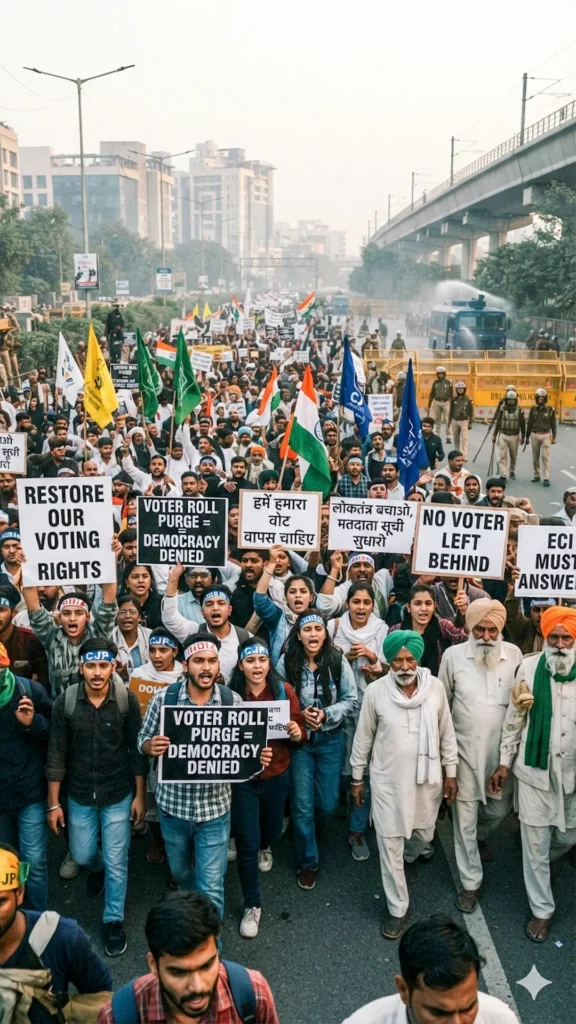
On Sunday 11 October, police detained students, a CPI(M) lawmaker and women protesters in Delhi and Mumbai as crowds demanded the resignation of Chief Election Commissioner Gyanesh Kumar. Within a week the India voter roll protests had spread to Hyderabad and Srinagar. On 20 October, about two dozen UN experts called for an independent investigation into the policing.
A popular framing holds that the India voter roll protests are a revolt against growing intolerance. After reviewing court filings, press investigations, survey data and independent analyses, this report reaches a narrower conclusion. The trigger is a dispute over how voter lists were cleaned and who controlled that process. Whether deeper hostility towards minorities lies beneath it is a serious question, and the evidence points in more than one direction.
At a glance
| Established | Disputed | Not yet known | |
| The revision | The Special Intensive Revision (SIR) struck over 13 crore names from draft rolls. The Supreme Court upheld its legality on 27 May. | Whether the Chief Election Commissioner bypassed the other two commissioners. | How the court will rule on the merits. |
| Who lost their vote | Analyses in Bihar, Bengal and Uttarakhand show uneven deletions: more Muslims, women and migrants. | Whether that reflects intent or flaws such as missing documents and name mismatches. | Official deletion data by religion, gender and caste. |
| Elections | In Bengal, deletions exceeded the winning margin in about half of the BJP’s seats. | Whether the SIR changed the result. The evidence is an association, not proof. | Any independent audit of the rolls. |
| Policing | Thousands were detained. The Supreme Court barred further illegal detentions. | The numbers, and whether force was excessive. The government says police acted lawfully. | An independent review. |
| Intolerance | Trackers record rising hate speech and violence against minorities. | How large the rise is, and whether it drives the protests. | A reliable official count. |
The spark: what The Indian Express found
The India voter roll protests trace to a 23 September investigation by Ritika Chopra in The Indian Express. It reported that two of India’s three election commissioners, Sukhbir Singh Sandhu and Vivek Joshi, had objected on the record at least 14 times in ten months to SIR decisions and orders issued without their knowledge.[1] The objections covered deletions and restorations, a July online change asking applicants whether their parents or grandparents were on the previous roll, and the centralisation of the roll database. Sandhu reportedly called the new question “unauthorised and illegal”.[1]
Commission decisions need unanimity or a majority, so if two of three members were bypassed, their validity is in question. The Express said it sent questions to the Commission and both commissioners before publication and received no reply.[1] The report does not itself allege that any community was targeted.
The reply, and the courts
The Commission says differing views are normal in its deliberations. In an affidavit filed on 26 October it told the Supreme Court that all three SIR orders, dated 24 June 2025, 27 October 2025 and 14 May 2026, were unanimous, that Form 6 itself had not been amended, and that a petition built on a single news report should not stand.[2] BJP spokesperson Sambit Patra said the dissent showed a commission functioning democratically and called the demand for the Chief Election Commissioner’s resignation a smear. Congress called the Commission’s first response damage control.
The courts have not settled the central question. On 5 October the Supreme Court issued notice on petitions seeking the Chief Election Commissioner’s suspension but declined to suspend him, and the Chief Justice clarified that the court had not approved the modified Form 6, contradicting an earlier Commission press release.[3] The petitioners were given ten days to answer the affidavit, with the next hearing likely on 17 November.[3] There is no finding on the merits.
That is separate from the court’s 27 May ruling, which upheld the SIR’s constitutional validity as advancing free and fair elections and held that deletion from the roll does not decide citizenship.[4] The present fight is about how decisions were made, not whether the exercise is lawful.
Who lost their vote
Independent analyses, mostly from civil-society or advocacy-linked groups, show that deletions fell unevenly. The Commission does not publish deletions by religion, gender or caste, so analysts infer religion from names, an imperfect method.
- Bihar. Muslims were 24.7% of the 65 lakh names excluded from the draft roll and 33% of the 3.66 lakh deleted from the final list, against 16.9% of the population, according to analysts Yadav and Shastri of Bharat Jodo Abhiyaan.[5]
- West Bengal. Of about 91 lakh names removed or under adjudication, 34.3% were Muslim against a 27% population share, but 63.4% were Hindu in absolute terms, many of them Scheduled Caste and Scheduled Tribe voters. Sabar Institute data show 61.8% were women, partly because married names did not match older records.[6]
- Uttarakhand. Districts with more Muslim residents saw more deletions, and in 45 of 70 constituencies deletions exceeded the 2022 winning margin. The analysts say religion was not a direct identifier and call for scrutiny, not proof of intent.[7]
Three points guard against over-reading. The pattern is not only about Muslims: researchers in Bengal found that Matua refugees, a Hindu Scheduled Caste community, and migrant workers were also heavily hit. Claims by some BJP leaders of one crore illegal Bangladeshi or Rohingya voters in Bengal found little support in the final figures.[6] And the Commission says its aim is a roll that excludes no eligible citizen and includes no ineligible one, a purpose the Supreme Court has backed.
Did the deletions change who won? The evidence shows an association, not proof. The BJP won 207 of 294 seats in Bengal on 4 May. Sabar Institute data show deletions exceeded the winning margin in 102 of those seats.[8] A Scroll analysis found that constituencies where the roll shrank more swung further towards the BJP, but stressed that this does not identify wrongful deletions or prove cause. The same test in Bihar shows no such pattern.[8] Political scientist Gilles Verniers argues the SIR makes any firm conclusion about Bengal’s verdict impossible. Defeated chief minister Mamata Banerjee alleged a conspiracy; the BJP and the Commission deny the revision favoured any party.
India voter roll protests on the streets, and the state’s response
Student groups, including the All India Students’ Association and the Cockroach Janta Party (CJP), lead the movement, with opposition parties marching alongside. Organisers describe the demonstrations as peaceful. Delhi Police imposed Section 163 of the BNSS, the successor to Section 144, across the New Delhi district, barring gatherings of five or more people. On 2 October more than 500 people were detained, including AAP leaders. On 9 October police refused permission for the CJP’s protest the next day, citing short notice and alleged breaches of earlier undertakings.[9]
Detentions began a day before the 10 October protest.[9] Estimates vary widely: Amnesty International and other rights groups said at least 10,000 people were detained across India around that date.[10] In an affidavit, Delhi Police said they deployed 15,000 personnel and cited disturbances on 6 to 8 October that injured officers and damaged detention buses. The Supreme Court ordered Section 163 notice boards removed from its own premises and barred further illegal detentions.[9]
On 20 October the UN experts said police had reportedly used force, including lathi charges, against unarmed students, stopped thousands from joining the protests, and raised reports of sexual and gender-based abuse.[10] India says law enforcement acted strictly in accordance with the law and has called earlier UN concerns an unacceptable interference in its internal affairs.[10] Both accounts can be partly true: some protests involved disturbances, and some detentions may still have been unlawful. Only an independent review of the evidence can separate them.
The generation behind the movement
The CJP began as satire. Founded on 16 May by Abhijeet Dipke, it went viral after remarks by Chief Justice Surya Kant that appeared to compare some unemployed young people and activists to cockroaches; Kant later said he meant only people with fraudulent degrees. Within weeks it had about 23 million Instagram followers, more than double the BJP’s account, mostly from Generation Z by its founder’s account.[11] Its first street protest was on 6 June, and a July protest over exam-paper leaks helped oust the education minister.
Critics note that Dipke trained in public relations and once interned in social media for the Aam Aadmi Party, and analysts warn the movement needs an offline organisation to last. Dipke says it has no immediate plan to contest elections. For this generation, the jobs question and the fairness question are intertwined.
Is this about intolerance?
Trackers show a troubling trend for minorities, but no authoritative public dataset confirms its size. India Hate Lab recorded 1,318 in-person hate speech events in 2025, 98% targeting Muslims and 88% occurring in BJP-ruled states; the BJP says the Lab presents a biased picture.[12] The one official series reviewed, National Crime Records Bureau figures cited by the Home Ministry, counts over 2,900 communal riot cases from 2017 to 2021 and stops there.[13] The South Asia Justice Campaign counted at least 44 Muslims killed in hate violence in the first eight months of 2026, while the right-leaning Organiser’s weekly tracker of incidents against Hindus logged 54 and 60 incidents in two weeks of May.[14] These are advocacy and media-compiled counts with different definitions and victims.
One data point cuts the other way. A 2024 Lokniti-CSDS survey found that 79% of respondents agreed India belongs to all religions equally, not just Hindus.[15] Attitude surveys and incident trackers measure different things, so both can be true.
The link between the India voter roll protests and intolerance is plausible but unproven. Some BJP leaders framed the SIR around removing illegal foreign voters, while the Commission’s stated aim is a clean roll. Where deletions fell heavily on Muslim-majority areas, critics see targeting; defenders point to documentation gaps, migration, name changes after marriage and the court’s backing. No source reviewed establishes intent.
India voter roll protests in a global wave
India’s protests share their generation, platforms and distrust of elites with a global wave, including the Gen Z protests in Nepal. Carnegie’s Global Protest Tracker recorded protests in more than 70 countries in 2025 and, by April 2026, roughly one new significant anti-government protest every four days, driven mainly by corruption, electoral manipulation and police brutality.[16] These trackers measure anti-government anger, not intolerance.
India differs in three ways: its trigger is the machinery of elections, not a tax or a social media ban; established opposition parties have joined the marches; and religious and caste identity sits in the backdrop. So far the protests have produced a minister’s exit but no change of government.
The roots: five layers
No single cause explains the India voter roll protests. The ratings below are this report’s own assessment of the evidence.
- Old anxiety about citizenship. Concern about foreign nationals on the roll’s dates to the 1980s; the SIR turns it into an administrative test. Evidence: strong on history, unclear on current intent.
- Electoral competition. A 2025 tracker found hate incidents rose during campaign periods. Evidence: moderate; trackers are contested.
- Economic stress. Anger over jobs, inflation and exam leaks fuelled the CJP’s rise. Evidence: moderate to strong.
- Technology and administration. Centralising the database reportedly led to 97 eligible voters being flagged in Goa, with no way to record the correction.[1] Evidence: moderate; needs an independent audit.
- Institutional trust. When a constitutional referee looks partisan, every dispute becomes existential. Lokniti-CSDS found only 28% trusted the Election Commission “to a great extent” in 2024, down from 51% in 2019, and 28.6% in a 2025 survey.[15] Distrust predates the SIR, so the revision landed on it rather than creating it. Evidence: strong that trust has fallen; contested who is to blame.
What we do not know, and what to watch
- Whether the commissioners were bypassed. The Supreme Court has not ruled.
- Whether any community was deliberately targeted. Disproportion is documented; intent is not.
- How many were detained or hurt. Estimates run from about 7,000 to more than 10,000.
Watch next: the court’s hearing; whether the Commission publishes deletion data by religion, gender and caste; and whether India accepts any independent review of the policing.
The bottom line
The India voter roll protests are real, large enough to draw UN attention, and driven first by a dispute over how India’s voter rolls are cleaned and who controls that process. On the evidence reviewed, they are not a protest against intolerance as such.
But the two stories touch. In several states the people hit hardest by deletions include Muslims, and some political leaders framed the exercise around removing illegal immigrants. Whether that overlap is design or side effect is the central unanswered question. Answering it needs data the Commission has not released and findings the courts have not yet made. Until then, the India voter roll protests will remain a test of whether Indians still trust the machinery that counts them.
How this report was prepared
This report draws on published sources to 30 October 2026: reports of court filings, press investigations, surveys and independent analyses. Advocacy-group analyses are labelled as such, and allegations are attributed, not asserted.
Key sources
[1] The Wire: https://thewire.in/government/2-out-of-3-election-commissioners-objected-14-times-in-10-months-on-sir · Khaleej Times: https://www.khaleejtimes.com/world/asia/election-commission-controversy-india-viral-report-explained-gyanesh-kumar-sandhu-joshi
[2] ThePrint: https://theprint.in/judiciary/all-sir-decisions-unanimous-form-6-wasnt-amended-eci-affidavit-in-supreme-court/3082271/
[3] LiveLaw: https://www.livelaw.in/top-stories/supreme-court-refuses-interim-plea-to-suspend-cec-gyanesh-kumars-issues-notice-on-plea-challenging-eci-decisions-553095 · The Logical Indian: https://thelogicalindian.com/supreme-court-gyanesh-kumar-sir-132048/
[4] LiveLaw: https://www.livelaw.in/top-stories/sir-meets-proportionality-test-conclusions-from-supreme-court-judgment-535887
[6] Free Press Journal: https://www.freepressjournal.in/analysis/west-bengal-sir-row-myths-data-and-the-voter-deletions-that-could-reshape-2026-elections · Behanbox: https://behanbox.com/?p=19330 · The Quint: https://www.thequint.com/news/politics/bengal-elections-matua-vote-sir-deletions-bjp-votebank-ground-report
[7] The Quint: https://www.thequint.com/news/breaking-news/muslim-heavy-districts-face-higher-voter-deletions-in-uttarakhand-sir-report
[8] The Caravan: https://caravanmagazine.in/politics/sir-westbengal-elections-deletions-analysis · Scroll: https://scroll.in/article/1093602/data-analysis-how-sir-deletions-shaped-bjps-landslide-in-bengal
[9] Outlook: https://www.outlookindia.com/national/delhi-police-detain-over-500-including-aap-atishi-and-sanjay-singh-at-jantar-mantar-protest · The Wire: https://thewire.in/law/delhi-court-sets-dipke-and-team-free-sc-hears-plea-on-police-detentions-during-october-10-protest · SC Observer: https://www.scobserver.in/journal/delhi-cec-protests-sc-seeks-police-orders-considers-plea-for-women-led-committee/
[10] Al Jazeera: https://aljazeera.com/news/2026/10/21/un-experts-call-on-india-to-stop-using-excessive-force-against-protesters · The Logical Indian: https://thelogicalindian.com/?p=131180 · Reuters via Internazionale: https://www.internazionale.it/ultime-notizie-reuters/2026/10/21/un-experts-urge-indian-authorities-to-cease-use-of-excessive-force-to-curb-protests
[11] Reuters via Khaleej Times: https://www.khaleejtimes.com/world/asia/india-gen-z-cockroach-janta-party-analysis · The Week: https://theweek.com/politics/why-indias-youth-are-flocking-to-a-fake-political-party
[12] Dawn: https://www.dawn.com/news/1966872 · Counterview: https://www.counterview.net/2026/01/report-finds-28-communal-riots-14-mob.html
[13] Maktoob: https://maktoobmedia.com/india/over-2900-communal-violence-cases-registered-in-india-in-last-5-years-data/
[14] Madhyamam: https://madhyamamonline.com/amp/india/44-muslims-killed-in-hate-violence-in-eight-months-2026-could-be-deadliest-year-yet-1546337 · Organiser: https://organiser.org/2026/07/26/371239/bharat/hindu-hate-watch-weekly-tracker-54-cases-of-communal-violence-conversions-religious-tensions-reported-across-india/
[15] National Herald: https://www.nationalheraldindia.com/national/india-belongs-to-all-religions-say-79-percent-of-respondents-in-lokniti-csds-study · The South First: https://thesouthfirst.com/news/trust-deficit-less-than-30-percent-voters-show-strong-trust-in-eci-lokniti-csds-survey-finds[16] Carnegie Endowment: https://carnegieendowment.org/publications/83445